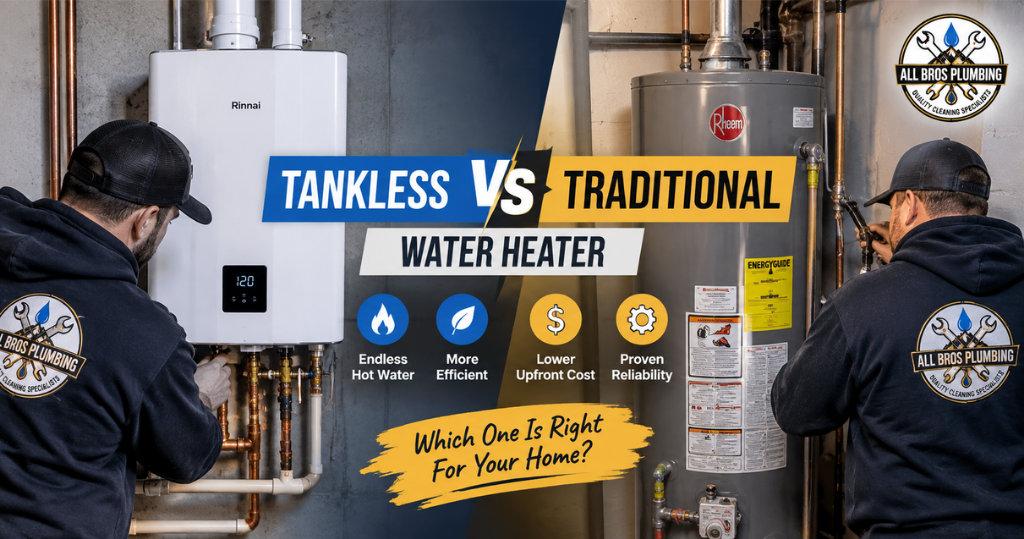
Choosing between a tankless and traditional water heater comes down to three things: your hot water demand, your budget, and your home’s existing setup.
Tankless systems save space and reduce standby heat loss, while traditional tank heaters usually cost less to install and offer a simpler replacement.
This guide compares tankless vs traditional water heater systems clearly so you can decide which one fits your household, budget, and long-term plans in Norwalk, CA.
Key Takeaways
- Traditional tank water heaters cost less upfront and are simpler to replace in most homes.
- Tankless (on-demand) units heat water only when needed, use less energy over time, and usually last longer.
- The right choice depends on your peak hot water demand, available space, budget, and how long you plan to stay in the home.
- Hard water, common in many Southern California areas including Norwalk, affects maintenance needs for both systems.
- Proper sizing and professional installation matter more than the technology alone.
Tankless vs Traditional Water Heater: Quick Comparison
| Feature | Tankless Water Heater | Traditional Water Heater |
| Hot water supply | Continuous within rated flow | Limited by tank capacity |
| Upfront cost | Usually higher | Usually lower |
| Energy use | Lower standby loss | Higher standby loss |
| Space | Compact, wall mounted | Larger tank |
| Expected lifespan | Around 20 years for many gas models | Around 10 to 15 years |
| Installation | More involved | Usually simpler |
| Best for | Long term efficiency and space savings | Lower upfront cost and simple replacement |
For many homeowners, the real choice is simple: pay more upfront for a tankless system with different long term benefits, or choose a traditional tank for a simpler and lower cost replacement.
On Demand Water Heater vs Tank: How They Actually Differ
On demand water heater vs tank comes down to one core difference. A traditional tank stores 40 to 80 gallons of water and keeps it heated around the clock, ready whenever a faucet turns on.
A tankless system skips storage entirely and heats water directly as it flows through the unit, which means it is only working when hot water is actually being used.
That single difference is what drives most of the cost, space, and efficiency gaps between the two systems.
Which One Costs More to Install?
Tankless Water Heater
Tankless water heater cost in Norwalk depends on the unit size, fuel type, and whether upgrades are needed. Installed costs commonly range from roughly $2,500 to $5,500 or more.
Many homes require larger gas lines, new venting, or electrical service upgrades when converting from a tank system. These changes are a major part of the total price.
Traditional Water Heater
Replacing a traditional tank unit with a similar model is usually less expensive. Installed costs often fall between $1,200 and $2,500 for a standard residential unit when existing connections can be reused. The simpler installation keeps labor and material costs lower.
Traditional Water Heater vs Tankless Energy Savings
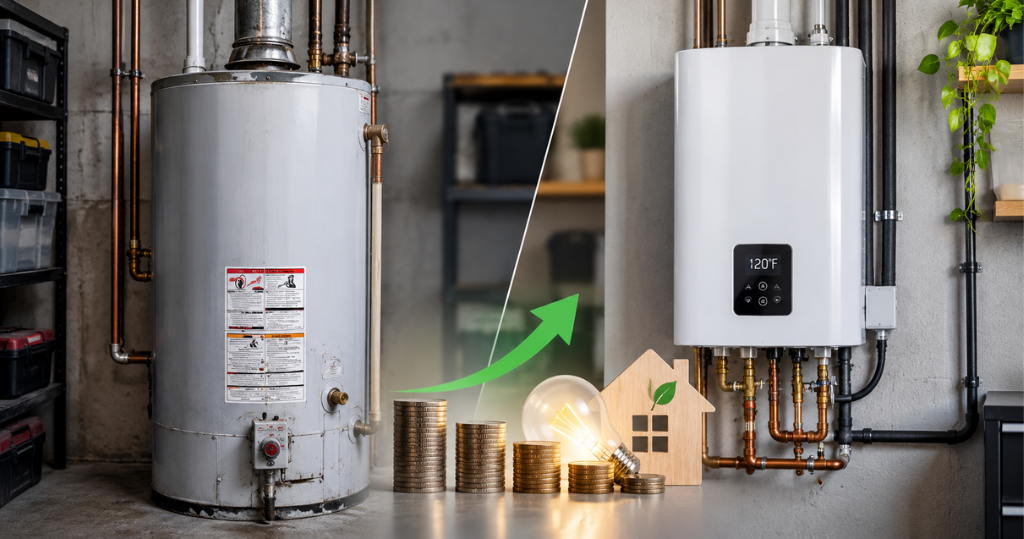
Traditional water heater vs tankless energy savings is one of the clearest differences between the two systems. Because a tank keeps water heated at all times, it loses energy to standby heat even when no one is using hot water.
A tankless system avoids that loss entirely by only heating water on demand, and ENERGY STAR certified tankless units can save a household meaningful money on energy bills every year compared to a standard gas tank.
How Long Does Each Water Heater Last?
Water heater lifespan depends on maintenance, water quality, usage, installation quality, and the condition of the system.
A traditional storage tank often lasts around 10 to 15 years, while a properly maintained tankless system often lasts 20 years or longer. ENERGY STAR and the U.S. Department of Energy both recognize the longer service life associated with many tankless systems. (ENERGY STAR)
If your current heater is approaching the end of its expected lifespan, compare replacement options before it fails. A planned replacement gives you time to evaluate both systems instead of making a decision during an emergency.
Tankless Water Heater Pros and Cons
ankless systems offer clear advantages, but they also have limitations that deserve attention before installation.
Pros:
- Less standby heat loss
- Compact wall mounted design
- Longer expected service life
- Continuous hot water within the unit’s rated flow
- No large storage tank
Cons:
- Higher upfront installation cost
- More complex installation
- Limited by flow rate
- Requires proper gas or electrical capacity
- Regular maintenance remains important
Is a Tankless Water Heater Worth It in Norwalk, CA?
A tankless water heater is worth considering in Norwalk when the home has the right setup and the long term benefits match your priorities.
Homes with older gas lines or electrical panels may also need upgrades before installation, which adds to the upfront cost.
That said, for households that use a lot of hot water daily, the long term energy savings and continuous supply often make the investment worthwhile once those upfront factors are accounted for. Water heater repair Norwalk CA technicians who know the local water conditions can give you a realistic answer specific to your property.
Which Water Heater Should You Choose?
Choose a tankless water heater when you prioritize long term efficiency, compact installation, and a longer expected service life. It is also a strong option for households that use hot water throughout the day and have suitable gas or electrical capacity.
Choose a traditional water heater when lower upfront cost and straightforward replacement are more important. It also remains a practical choice when the existing setup already supports a properly sized storage tank.
If you are dealing with an urgent failure, our emergency plumber Norwalk CA service is available to restore hot water quickly.
Frequently Asked Questions
Does a tankless water heater give you hot water faster than a tank?
Not necessarily. Both systems still need time for hot water to travel through the plumbing from the heater to the fixture. A tankless system starts heating water when there is demand, while a tank already has heated water stored. The distance between the heater and fixture often has more impact on wait time than the heater type.
Can a tankless water heater handle two showers at the same time?
Yes, if the unit has enough flow capacity for the combined demand. The important number is the heater’s rated gallons per minute, along with the required temperature rise. A small unit serving several fixtures at once could struggle to maintain the desired temperature.
Does a tankless water heater need more maintenance than a traditional tank?
Tankless systems need regular maintenance, especially where mineral scale is a concern. Periodic flushing or descaling helps protect the heat exchanger and maintain proper performance. Traditional tanks also need maintenance, including sediment removal and inspection of components.
What is the biggest mistake homeowners make when choosing a tankless water heater?
Choosing the unit based only on its advertised capacity or energy savings is a common mistake. The system needs to match the home’s peak hot water demand, fuel supply, venting, electrical requirements, and installation conditions. Proper sizing and installation matter as much as the heater itself.
Do tankless water heaters really save money on energy bills?
Most households see lower operating costs because tankless units avoid standby heat loss. Actual savings usually range from $70 to $120 per year depending on usage, fuel type, and local energy rates. High-demand homes see smaller percentage savings.
Ready to upgrade your water heater in Norwalk?
All Bros Plumbing helps homeowners decide between tankless and traditional systems based on their actual home, not a generic recommendation.
As your local plumber Norwalk CA homeowners trust, we also offer plumber Norwalk CA service if your current water heater fails without warning. Call today for a straightforward quote.